The latest wave of attention around The Odyssey is not just about myth, spectacle, or star power. It is also about AI: one version of the story has been turned into a fully AI-generated feature, while other AI-assisted experiments have fuelled a wider debate about where filmmaking is headed.
That makes The Odyssey a surprisingly useful lens for the AI conversation. A poem about endurance, transformation, and the unknown now sits beside tools that promise to compress production time, cut cost, and let a small team create something that once required a studio-sized machine.
Why the AI angle matters
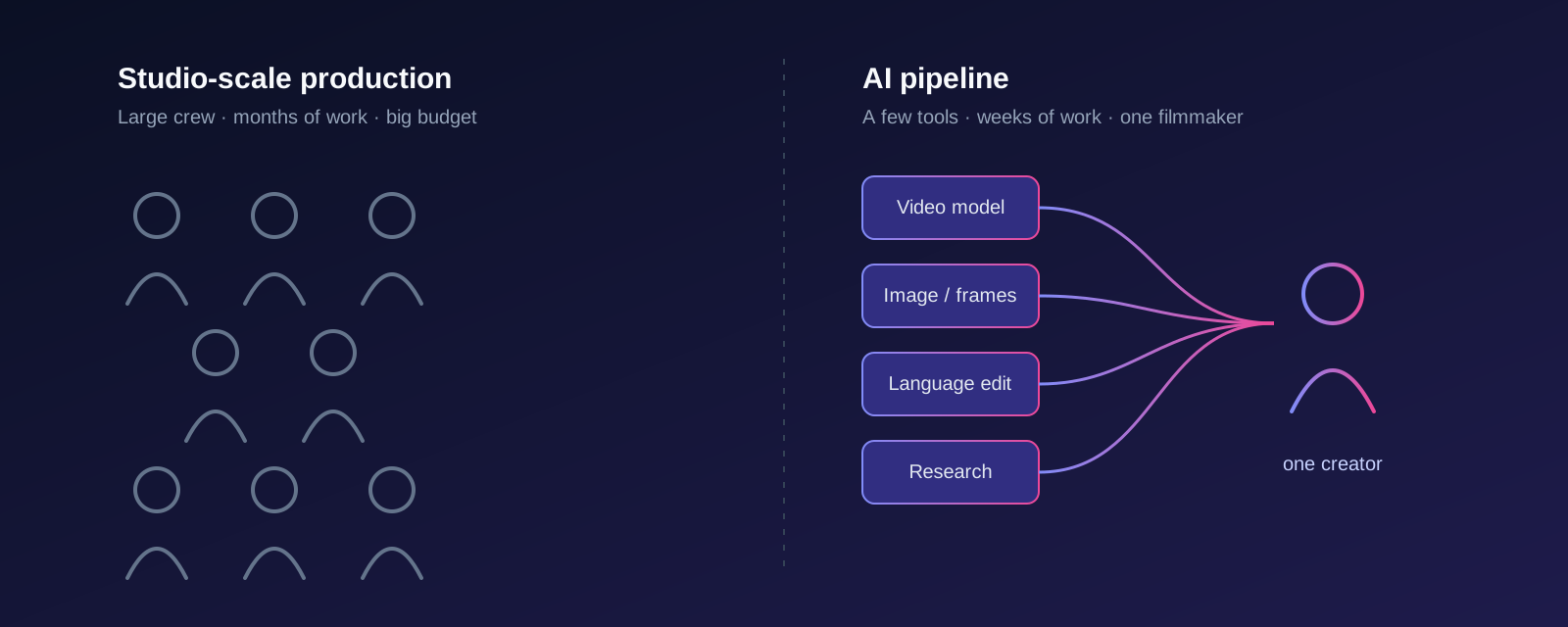
The clearest example is Odysseus: The Fall, unveiled in July 2026 by the AI film company Fountain 0 and creator Ash Koosha. The studio describes it as a 135-minute feature built entirely with AI, and says it stitched together several models to do it: ByteDance's Kling for video generation, Google's Nanobanana for imagery and key frames, Anthropic's Claude for language editing, and Google's Gemini for research support.
The headline claim is the economics. Fountain 0 says the film took only a few months of part-time work and cost in the region of the mid-five figures — a fraction of a conventional feature's budget — and it is positioned as proof that a single filmmaker can build a feature-length work with a radically smaller team. That claim is exactly what gives the project its buzz and its controversy: supporters see a creative breakthrough, while critics hear a warning bell about synthetic filmmaking replacing human crews, actors, and craft. The tech-news site Futurism, for one, was scathing.
A second, very different AI Odyssey
Fountain 0's feature was not the only AI retelling to ride the moment. Days later, in late July 2026, the interactive-video platform Yoroll launched its own AI Odyssey — but as something quite different: a playable film. Created by Amy Sun on Yoroll's AI-native platform, it reportedly assembled more than 140 AI-generated video segments into a branching story with eleven distinct endings and a choice every 30 to 50 seconds, built in a couple of days for a few hundred dollars.
The two projects are worth keeping separate, because they point at different futures. Odysseus: The Fall chases the traditional cinema format — a long-form feature you sit and watch. Yoroll's AI Odyssey chases interactivity, closer to a game than a film. What they share is the same underlying bet: that generative tools now let one person attempt what used to need a whole industry.
The Hollywood context
The timing matters because this AI conversation unfolded alongside a high-profile, decidedly non-AI blockbuster version of the same epic: Christopher Nolan's The Odyssey, released in July 2026 with Matt Damon as Odysseus and a stacked ensemble. Directed by Nolan — a filmmaker synonymous with large-format, practical, shot-on-real-film spectacle — it is about as far from an AI pipeline as a modern movie gets.
That contrast turned the title into a symbolic battleground. One camp is selling scale, performance, and practical cinema; the other is selling speed, automation, and reinvention. There is also a broader industry implication: if a myth this old can be recreated through AI pipelines, the question is no longer whether the tools can imitate cinema, but how audiences, studios, and artists decide what counts as legitimate filmmaking.
A strong angle: the perfect test case
The Odyssey is becoming the ideal test case for AI in entertainment because it is timeless enough to invite endless reinterpretation, yet famous enough to make every technical choice feel like a statement about the future of movies. Publishing an AI Odyssey in the same summer as a Nolan Odyssey is not a coincidence — it is a way to borrow the spotlight and force the comparison.
For viewers, the practical takeaway is simple: the label "a film of The Odyssey" now covers wildly different things, from a $250 million studio production to a mid-five-figure AI feature to a $250 playable experiment. Knowing which one you're about to watch — and how it was made — is quickly becoming part of the review. It's the same reason trustworthy, transparent reviews matter more than ever, a theme we explore in our guide to the best movie review sites in the UK.
Whichever side of the debate you land on, one thing is clear: the next chapter of The Odyssey won't only be judged on story and spectacle, but on how it was made. Keep an eye on our trending coverage as the AI-versus-cinema conversation keeps evolving.
References
- Hollywood Reporter — "Fully AI-Generated Feature Odysseus: The Fall Unveiled"
- Forbes — "Homer Epic 'The Odyssey' Gets A Full-Length AI-Generated Film"
- Business Wire — Fountain 0 press release announcing Odysseus: The Fall
- Futurism — critical take on the fully AI-generated Odyssey
- Yahoo Finance / GlobeNewswire — "Yoroll Launches AI Odyssey, a Playable AI Film Inspired by Homer's Epic"
- Wikipedia — Christopher Nolan's The Odyssey (2026 film)